How do 3-4 year olds get acquainted with math? Simple thinking activities that parents can apply at home
Posted on: 01/12/2025
Discover how to help your 3-4 year old child get acquainted with math through simple thinking activities at home such as classifying, counting, comparing and assembling. Suitable suggestions for parents whose children are studying at Binh Thanh kindergartens who want to develop their children's logical thinking.
The stage from 3–4 years old is considered the “golden moment” in a child’s development. This is when the child’s brain opens up most strongly for learning, exploring, and forming an important foundation for future thinking as well as long-term development.
Therefore, starting to guide your child from the age of 3–4 is a truly meaningful first step. Age-appropriate math thinking activities not only help children practice observation, reasoning, and information processing skills, but also build confidence and excitement whenever they approach the “world of mathematics.”
Math-thinking activities for children aged 3–4 are often designed as games with vivid illustrations and familiar, real-life situations. Instead of dry numbers, children interact with colors, shapes, sorting, and classifying… All of these help children absorb naturally, remember easily, and especially develop a love for learning math from the very beginning.
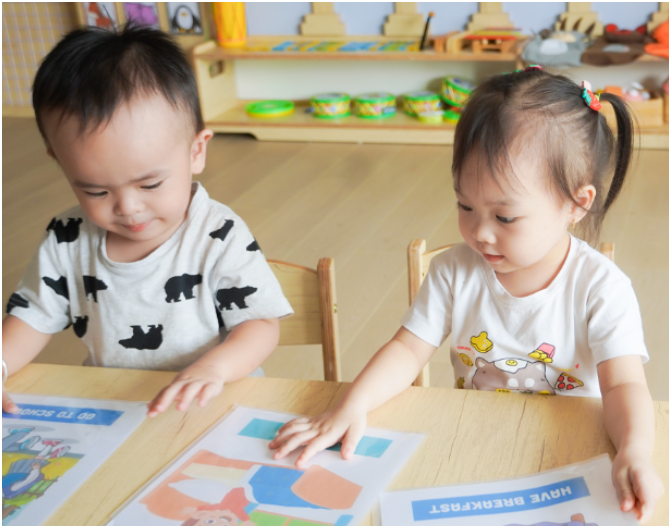
At kindergartens in Binh Thanh such as ICANDY Preschool, children at this age are exposed to mathematics through simple, visual, hands-on activities. Parents can absolutely apply the same methods at home to accompany their child every day.
What can children aged 3–4 learn in mathematics?
At this age, children learn several basic math concepts:
-
Recognizing quantities: one and many;
-
Recognizing and naming shapes and identifying them in real life;
-
Understanding comparison concepts: big – small, long – short, tall – short, and arranging accordingly;
-
Counting objects within the range of up to 5 (or more depending on ability);
-
Spatial awareness: above – below, front – back, right hand – left hand.
Math for preschoolers aged 3–4 consists of simple yet essential discoveries that help build the foundation for future logical thinking and math learning.
Why is age 3–4 the golden period to start developing math thinking?
-
The brain develops rapidly, and children learn effectively through observation and imitation.
-
High curiosity: children love to ask questions and explore differences between objects.
-
They begin to understand comparison and classification — key foundations of mathematics.
-
Improves patience and concentration, which later supports independent learning habits.
Math activities help children develop:
-
Concentration
-
Language skills
-
Memory
-
Problem-solving skills
At ICANDY Preschool (a bilingual-oriented kindergarten in Binh Thanh), teachers always create a playful learning environment so children can absorb knowledge naturally and joyfully.
7 simple math activities parents can apply at home
Sorting objects by color – size
Parents can use: bottle caps, wooden blocks, balls, kitchen items…
Ask your child:
-
“Put the red items here, okay?”
-
“Which one is bigger? Which one is smaller?”
→ Helps children recognize colors, sizes, and improve observation skills.
Simple counting games (1–3 or 1–5)
Use fruits, snacks, or small toys.
Examples:
-
“I have 3 grapes. Can you take 1 for me?”
-
“How many lego blocks are in this basket?”
→ Helps children learn quantities naturally.
Puzzle matching – block building
Children love items such as:
-
Stackable wooden blocks
-
Large lego blocks
-
Simple puzzles with 4–6 pieces
→ Develops spatial thinking, shape recognition, and fine motor skills.
Matching pairs game
Prepare pairs of identical objects: 2 spoons, 2 small plush toys…
The child’s task: find the matching pairs.
→ Enhances concentration and memory.
Ordering by size (small → large, short → tall)
Use 3–5 objects of different sizes.
Ask your child:
-
“Can you arrange them from smallest to biggest?”
-
“Which one is taller? Which one is shorter?”
→ Builds essential comparison skills in mathematics.
Identifying shapes using real objects
Instead of using books, parents can show:
-
Plate → circle
-
Door → rectangle
-
Napkin → square
→ Helps children understand shapes from real-life objects, making them easier to remember.
Pouring water – measuring volume
Use 2–3 cups of different sizes and a small water jug.
Have the child pour water and observe:
-
“Which cup has more water?”
-
“Which one has less?”
→ Introduces children to the concept of “volume” — an early form of measurement.
Important principles when teaching math to children aged 3–4
-
No forcing — only learn when the child is happy
-
Respect each child’s learning speed
-
Use concrete, visual examples
-
Repeat daily but vary the activities
-
Let the child do things independently — parents only guide
-
Use simple interactive questions: “Which one?”, “Where?”, “How many?”
When children feel happy and active during learning, their math thinking develops strongly without pressure.
ICANDY Preschool – A learning environment that encourages math thinking through experience
At ICANDY Preschool — one of the kindergartens in Binh Thanh trusted by many parents — children aged 3–4 learn math through:
-
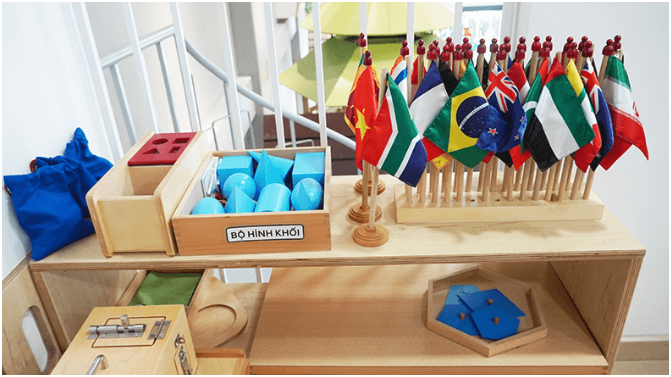
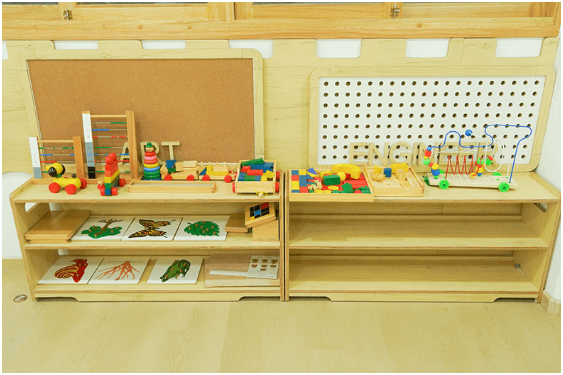
Montessori learning materials – a wide range of educational tools
-
Spacious classrooms with multiple practice corners
-
Daily outdoor exploration activities
-
Interactive lessons using smart screens and modern projectors
-
Teachers who accompany students closely and update parents with daily reports
Thanks to this approach, children develop early mathematical thinking naturally — through play, movement, and exploration-driven activities.
