In recent years, the Montessori method has gained increasing attention from Vietnamese parents seeking an educational model that helps children develop naturally, independently, and holistically.
In recent years, the Montessori method has attracted increasing interest from Vietnamese parents who are seeking an educational approach that supports children’s natural, independent, and holistic development. So what exactly is Montessori, what principles does it follow, and what core educational goals does it aim to achieve for children? The article below will help you gain a clearer understanding—while also highlighting how ICANDY Preschool applies the Montessori spirit in children’s daily learning environments.
What is the Montessori method?
Montessori is an educational method developed in the early 20th century by Dr. Maria Montessori—an Italian physician and educator.
The distinctive feature of Montessori is its respect for each child’s individuality, creating conditions for children to learn independently through experience and to take ownership of their exploration of the world.
Montessori is not about “early academic learning” or “cramming knowledge.” Instead, it encourages children to learn through hands-on activities, sensory experiences, curiosity, and independence—rather than passive learning.
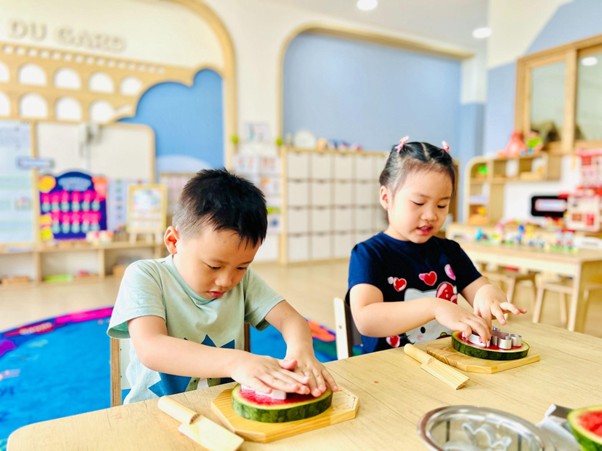
Core principles of the Montessori method
Respect for the child
Each child is regarded as an independent individual with their own thoughts and needs. Teachers do not impose instruction but act as observers, companions, and gentle guides.
Freedom within limits
Children are free to choose their activities, concentration time, and ways of working—within the boundaries of safety and classroom rules.
Prepared environment
The learning space is thoughtfully designed: materials are within reach, neatly organized, and clearly divided into functional areas. Everything supports children in self-care and independent exploration.
Learning by doing
“The hand is the instrument of the mind.” Children engage in real-life activities such as pouring water, wiping tables, sorting objects, stringing beads, and assembling shapes—helping develop thinking skills, motor coordination, and concentration.
The role of the adult
Montessori teachers observe to understand each child’s developmental pace and provide support at the right moment—without doing tasks for the child or directing excessively.
Core educational goals of Montessori
Developing independence
Children learn to take care of themselves and their environment: dressing independently, tidying toys, preparing meals, and more. This fosters confidence and initiative.
Building concentration
Repetitive, precise, and sequential activities help children develop sustained concentration—an essential foundation for future learning.
Developing logical thinking and problem-solving skills
Montessori emphasizes graded materials, classification, and patterns, stimulating observation, reasoning, and trial-and-error thinking.
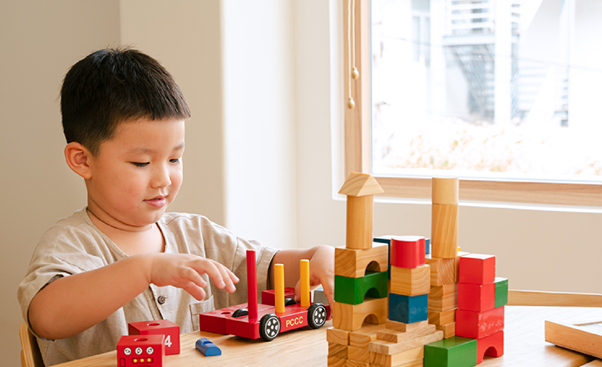
Nurturing respect and cooperation
Children learn to line up, take turns, share materials, and support peers—thereby developing positive character traits and social skills.
Holistic development across five key areas
Montessori supports development in five domains:
-
Practical Life
-
Sensorial
-
Language
-
Mathematics
-
Culture
How does ICANDY Preschool apply the Montessori spirit?
ICANDY Preschool is not a 100% Montessori school, but it selectively applies the core principles and spirit of Montessori to optimize children’s natural development:
Classrooms arranged by learning corners – creating a Montessori-inspired prepared environment
Learning areas such as creative corners, role-play corners, fine motor skill areas, and reading corners are scientifically organized, tidy, and accessible to children.
Children are encouraged to choose their own activities
At various times during the day, children can select their preferred learning corners and decide what activities to engage in—helping nurture individuality and personal interests.
Teachers observe without excessive intervention
ICANDY teachers focus on observation and encourage children to take ownership of their learning process, identifying strengths and providing timely support where needed.
Daily English learning with native teachers
Alongside a natural and child-led learning approach, children are exposed to English for 60 minutes every day with native teachers, enhancing confident communication skills.
Extracurricular activities – enriching life skills
Beyond classroom learning, ICANDY offers regular free field trips, swimming, aerobics, and other activities—helping children build confidence, courage, and social skills.
Conclusion
Montessori is not only an educational method but also a way of seeing children—with respect, companionship, and encouragement of independence. Applying the Montessori spirit in early childhood education helps children build a strong foundation for long-term development.
ICANDY Preschool is a suitable choice for parents who want their children to learn in an environment that values experience, independence, creativity, and natural bilingual communication.
