What is a bilingual preschool? Things parents need to know before choosing one.
Posted on: 26/12/2025
What is a bilingual preschool? This article helps parents understand the benefits, how to teach bilingualism appropriately for preschool children, and what to consider before choosing a school for their child.
In recent years, bilingual preschools have attracted increasing attention from parents when choosing an early learning environment for their children. However, not all parents clearly understand what a bilingual preschool is, how bilingual learning should be implemented appropriately, and which important criteria should be considered before making a decision.
The article below will help parents gain a clear understanding and make the right choice of a bilingual preschool for their child during the early years.
What is a bilingual preschool?
A bilingual preschool is an educational model in which children are exposed to and learn two languages—most commonly Vietnamese and English—from their early years.
Unlike learning English as a separate subject, the bilingual approach helps children:
-
Listen to, understand, and respond to English naturally
-
Become familiar with a new language through daily routines and play
-
Avoid academic pressure or rote memorization
Most importantly, bilingual education at the preschool level does not focus on vocabulary or grammar, but rather on building positive emotions and confidence in communication.
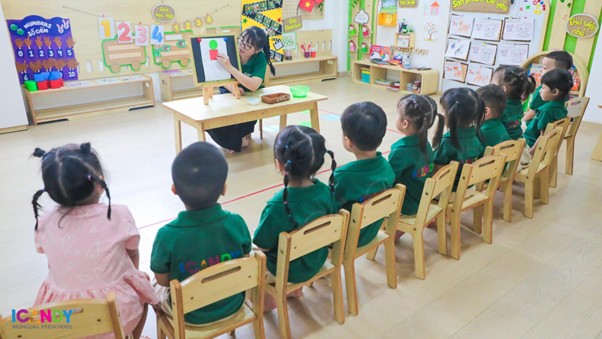
Why do many parents choose bilingual preschools for their children?
Early exposure to English in a suitable environment brings many long-term benefits:
Natural language development
Preschool children have a strong ability to absorb languages. When they regularly hear and use English, they can naturally develop language reflexes without pressure.
Increased confidence in communication
Children who are accustomed to communicating in two languages tend to be more confident, less afraid of making mistakes, and more adaptable in new environments.
Stimulating thinking and cognitive flexibility
Bilingual learning helps children develop multi-dimensional thinking and flexibility in expression and problem-solving.
However, starting bilingual education early is not automatically beneficial; what matters most is learning in the right way, with appropriate intensity, and in line with the child’s age.
.jpg)
How should preschool children learn bilingually in an appropriate way?
This is a common concern among many parents. For preschoolers, bilingual learning should ensure the following:
-
An appropriate amount of English exposure without causing overload
-
Learning through play, songs, movement, and daily communication
-
No pressure to speak or memorize vocabulary
-
A harmonious balance between Vietnamese and English
A good bilingual environment is one where children feel happy and comfortable, viewing English as a natural part of daily life.
What parents should know before choosing a bilingual preschool
Is the amount of English suitable for the child’s age?
Parents should find out:
-
How long does the child learn English each day?
-
Is the duration flexibly adjusted according to age?
For preschool children, quality and approach are more important than the number of hours.
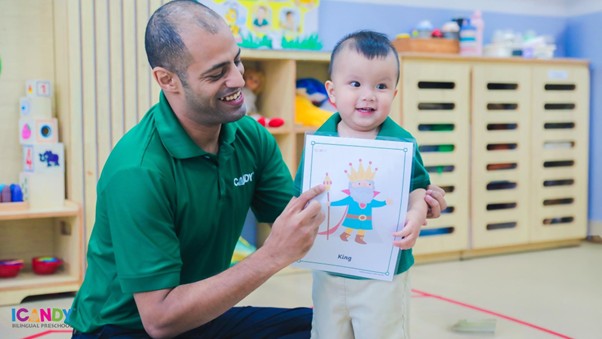
Who are the English teachers?
A suitable bilingual preschool should have:
-
Native or English teachers with experience working with young children
-
A gentle, friendly teaching approach that makes children feel safe
Teachers not only teach language but also build emotional connections and encourage children to communicate.
Does the learning environment encourage communication?
Classroom and activity spaces have a significant impact on children’s communication skills:
-
Spacious classrooms with multiple play and creative corners
-
Opportunities for group work, sharing, and discussion
-
A variety of experiential and outdoor activities
An open environment encourages children to actively use language rather than learn passively.
Does the school focus on children’s holistic development?
Bilingual education is only one part of a preschool child’s overall development. Parents should also consider:
-
Physical and movement activities
-
Emotional care and social skills
-
Safety, nutrition, and hygiene
A good school is where children learn, play, and develop in a balanced way every day.
Bilingual preschool environment at ICANDY Preschool – Binh Thanh
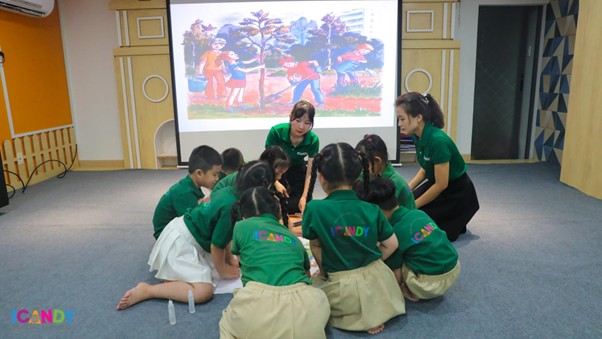
At ICANDY Preschool, the bilingual preschool model is designed to be appropriate, gentle, and child-centered.
-
Children learn English daily with foreign teachers, for a minimum of 60 minutes per day, flexibly adjusted according to age
-
English is integrated into games, activities, and everyday communication
-
Spacious classrooms with multiple play corners encourage active interaction
-
Daily physical activities and extracurricular programs such as swimming and rhythmic exercises
-
The swimming pool uses high-quality salt electrolysis technology, chlorine-free, safe for children’s skin and eyes
-
Technology-enhanced learning with interactive screens and projectors, making lessons more engaging
In addition, the school places strong emphasis on connecting with parents through daily reports and workshops, helping families better understand and support their children.
Choosing a bilingual preschool – choose what fits your child
There is no single model that is “best for everyone”—only the environment that best suits each individual child. When choosing a bilingual preschool, parents should prioritize:
-
The child’s comfort and emotional well-being
-
A gentle, pressure-free approach
-
A safe, loving, and respectful environment
Because for preschool children, the joy of going to school and confidence in communication are the most important foundations for their future learning journey.
